Showing posts with label Shivaji Maharaj. Show all posts
Showing posts with label Shivaji Maharaj. Show all posts
Saturday, March 5, 2011


Monday, August 16, 2010
Chatrapati Shivaji Maharaj meeting with Afzal Khan (video clips)
Two movie clips of Chatrapati Shivaji Maharaj's encounter with Afzhal Khan
A movie showing the legendary strength of Afzhal Khan
A movie showing all the strength coming to naught as Chatrapati Shivaji Maharaj tears Afzhal Khans chest and decapitates his head.
Other related posts in this blog
http://sowingseedsofthought.blogspot.com/2010/04/night-attack-of-shivaji-on-shaista-khan.html
http://sowingseedsofthought.blogspot.com/2010/03/chatrapati-shivaji-maharajs-visit-and.html
http://sowingseedsofthought.blogspot.com/2010/03/chatrapati-shivaji-maharajs-letter-of.html
http://sowingseedsofthought.blogspot.com/2010/06/baji-raos-letter-to-chimanji-appa.html
A movie showing the legendary strength of Afzhal Khan
A movie showing all the strength coming to naught as Chatrapati Shivaji Maharaj tears Afzhal Khans chest and decapitates his head.
Other related posts in this blog
http://sowingseedsofthought.blogspot.com/2010/04/night-attack-of-shivaji-on-shaista-khan.html
http://sowingseedsofthought.blogspot.com/2010/03/chatrapati-shivaji-maharajs-visit-and.html
http://sowingseedsofthought.blogspot.com/2010/03/chatrapati-shivaji-maharajs-letter-of.html
http://sowingseedsofthought.blogspot.com/2010/06/baji-raos-letter-to-chimanji-appa.html
Chatrapati Shivaji Maharaj's attitude towards women!!!
As per legend Shivaji returns the daughter of the mullah of Kalyan. Shivaji Maharaj's thinking and foresight was way ahead of his time. He was a modern ruler in a bigoted medieval period.
Saturday, March 27, 2010
Chatrapati Shivaji Maharaj's visit and escape from Aurangzebs court in 1666.
Shivaji’ visit to Aurangzeb in 1666

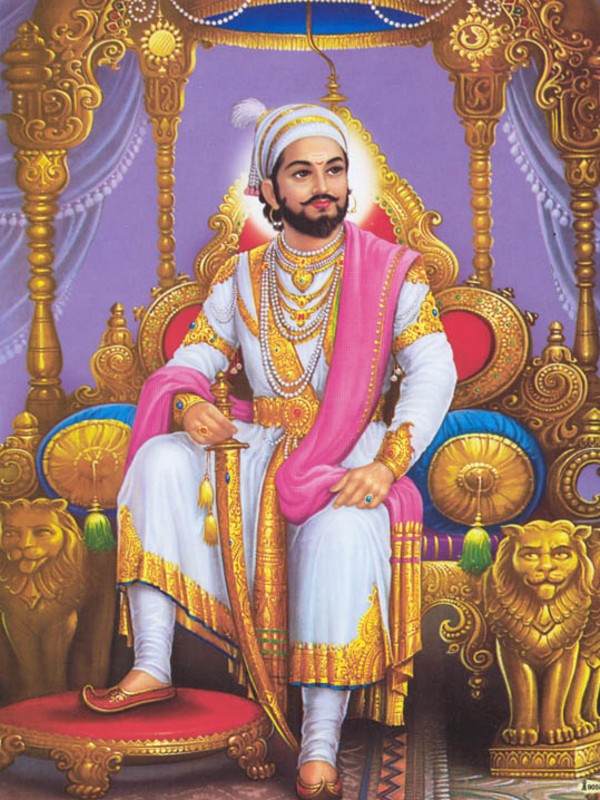
This is one of the most celebrated events in the history of the great Maratha King, the visit to the mughal court of Aurangzeb. His escape not so much his visit attracts all the story telling. But it is important that the visit and the reasons behind it are told. Also important is that the reason behind his imprisonment and subsequent escape.
In the years preceding 1666 Raja Jai Singh the great Rajput King and the greatest general of the Mughal army was sent by Aurangzeb with a great army to subdue the Maratha warlord. He was somewhat successful. He was able to take some of the important forts and reduce the strategic manoeuvrability and economics of Shivaji. But this of course came at a great cost to the mughals in terms of men and material. The mughal army at large and Raja Jai Singh in particular was a general of wide open battle fields with massive batteries of cannons, wide deployment of units and flanking cavalry. The Deccan fields did not allow for such set piece luxury and thus resulted in limited success but the size of the army provided for occupation of what ever they could win but nothing decisive came from it. Shivaji the shrewd general and statesman opened negotiations to buy time and read the oppositions objectives. The outcome was he accepted being a vassal of the mughal Aurangzeb and supported Jai Singh in the further conquest of the Deccan viz. Bijapur and Golconda.
Sometime after this treaty Jai Singh tired of his long campaign in the Deccan which started on 30th September 1664 wanted a replacement and with none found capable decided to use Shivaji as the above. For this to happen he set in motion all the contrivances available to him including offering the Viceroyalty of the Deccan to Shivaji. This was not really promised by Aurangzeb. At any rate Shivaji was induced to visit the mughal court to receive this honour and lets say appointment papers. Shivaji on the other hand saw this opportunity to get a legitimate Viceroyalty and later expand as an independent ruler of the whole of Deccan at the expense of the mughals. Imagine the great mughal corporate machinery providing for him to conquer Bijapur and Golconda after which he can do as he pleases. This was the foresight, vision and courage of the great man, taking the prey out of the tiger’s fangs.
Shivaji thus left for the mughal court in March of 1666 and was supposed to arrive on 11th May 1666 a day before Aurangzeb’s coronation so that he could be showed the manners of the court. 12th May was the date when Aurangzeb was to formally become emperor of Hindustan some 5 months after Shah Jehan died. Aurangzeb had usurped the throne in 1658 but did not take the title of emperor till his father died. Thus on the day of his formal coronation was also the day when Shivaji was to meet the tyrant. But things did not go as planned. Shivaji due to travel delays arrived on the 12th of May and thus had no chance of being introduced to the formal and stifling mughal court. He was straight away escorted to the ‘Diwan i Khas’. Shivaji paid respect and submitted gifts and during this entire period Aurangzeb did not say a word to Shivaji as a mark of welcome, recognition or acknowledgement and was made to stand behind a row of ‘5 hazari’ noblemen (5 thousand horse noblemen). Shivaji was forgotten after this and the court formalities proceeded as normal.
Let’s take a quick peep into Shivaji’s mind. This was the not the reception he had in mind considering the promises made by Raja Jai Singh the high and mighty mughal general. His mind was ill at ease since he entered Agra. First he had been welcomed not outside Agra as per protocol but in the heart of the city and that too by Ram Singh (son of Jai Singh) and Mukhlis Khan junior officers. No presents or gifts or high titles were given to welcome him and finally he was made to stand behind 5 hazaris. When he learnt that he was standing behind 5 hazaris “What!” he exclaimed “My son of nine years was created a 5 hazari in absentia, my general Netaji Raoji is a 5 hazari. And I am standing behind them” Then he asked who was the person in front of him. Ram Singh replied it was Raja Jaswant Singh. This was the final straw. “Jaswant, whose back my soldiers have seen! I stand behind him? What does this mean”? Many hours of torment, disrespect and pride he swallowed since his arrival but this was it. He walked out of the Diwan i Khas. His departure was not unnoticed as the place was of limited audience and presence. It was a step he took at the end of which he said to Ram Singh “My destined day of death has arrived, either you will slay me, or I kill myself. Cut off my head, if you like, but I am not going to the emperor’s presence again”. He never did.
Days passed in diplomatic exchanges between Shivaji and the emperor to soothe nerves and seizing this breach Raja Jaswant Singh and the emperor’s harem hatched a conspiracy to arrest or kill Shivaji. Aurangzeb accepted this plan. Shivaji was imprisoned in his house. He was destined to die or exile to Kabul.
Using the delays in the royal court proceedings to kill or exile Shivaji to Kabul, Shivaji started planning escape. Shivaji feigned illness and sent out sweets to Brahmins, religious mendicants and Hindu courtiers. They were carried in huge baskets slung on a pole carried by two men and each day this happened without fail and the guards searched without fail. After a few weeks the guards went slack and stopped searching and this is what Shivaji was waiting for. On the 19th of August 1666 he and his son Shambhuji got into 2 baskets and escaped. Outside the city Maratha infantry officers comprising of Niraji Raoji, Datta Trimbak and Raghumitra escorted the two fugitives dressed as mendicants via Mathura to Prayag and from there to Varansi and then into Chattisgarh, Golconda and then into Raigarh fort.
Suspicion fell on Ram Singh the son of Raja Jai Singh and rightly so. Ram Singh was in connivance but never directly involved. Ram Singh was deposed of his rank and forbidden court duties. Things reverted to normalcy soon after his powerful father came back to Agra. In the interim Ram Singh acted gallantly and challenged the emperor to defame him. Aurangzeb knowing the delicacy of the situation did not push his luck with the Rajput.
All details are taken from the book of Sir Jadunath Sarkar ‘Shivaji and his times’ and from the Dingal letters of Ram Singh and other Rajput nobles preserved in Jaipur.
At the end I just wanted to state that the mughal rule in India was sustained and prolonged by the sword of the Rajputs. As per Baburnama which I have read and is on my shelf there was no more that 5 thousand Uzbek fighters in Baburs army, the rest were Hindu Jat, Rajput mercenaries which amounted to 40 thousand. Similarly, mughals used a bulk of Hindu warriors to fight their wars. Rajputs needed someone like Shivaji and not Jai Singh to throw the mughals out though all Rajputs sympathised with Shivaji’s cause and aided and abetted his conquest in many ways but never pulled the plug on the mughals but in fact conspired against each other. They were ok to serve the mughals and were even more reconciled to allow a non Rajput to steal the show but never allowed themselves the combined chance of victory. This is reflected in India’s current political atmosphere. We Hindus are no better than the Rajputs and Jats 400 years back.
Read other episodes: http://sowingseedsofthought.blogspot.com/2010/03/chatrapati-shivaji-maharajs-letter-of.html
Read other episodes: http://sowingseedsofthought.blogspot.com/2010/03/chatrapati-shivaji-maharajs-letter-of.html
Wednesday, March 24, 2010
Chatrapati Shivaji Maharaj's letter of protest to Aurangzeb 'jaziya' - religious tax
My attempt is to capture in capsules the history of the glorious Maratha empire which still has impact on our lives without even us being aware of it.
Below is a 'one of its kind' letter written by Chatrapati Shivaji Maharaj to Aurangzeb protesting the Jaziya tax applied on all non Muslims. This letter was written some years after his epic escape from Agra. There are some positive references to Akbar, Jehangir and Shah Jehan but I really doubt the good nature of these Kings. Their record is as dubious as Aurangzebs contrary to what we are taught in school. Shivaji Maharaj the shrewed statesman that he was used this opportunity to sarcastically prick Aurangzeb, alluding that unlike his ancestors who were good, compared to them he is a common criminal, a murderer of his own father and a usurper of the throne.
Shivaji’s letter on religious toleration to Aurangzeb
Shivaji sent to Aurangzeb a well-reasoned and spirited letter of protest against the jaziya polltax, which was drafted by Nila Prabhu in eloquent Persian translated here into English for the reader.
To the Emperor Alamgir –
“It has recently come to my ears that, on the ground of the war with me having exhausted your wealth and emptied your treasury, your Majesty has ordered that money under the name of jaziya should be collected from the Hindus and imperial needs supplied with it. May it please your Majesty! That architect of the fabric of empire, [Jalal-ud-din] Akbar Padishah, reigned with full power for 52[lunar] years. He adopted the admirable policy of universal harmony (sulh-i-kul) in relation to all the various sects, such as Christians, Jews, Muslims, Dadu’s followers, sky-worshippers (falakia), malakia, heathens (ansaria), atheists (daharia), Brahmans and Jain priests. The aim of his liberal heart was to cherish and protect all the people. So, he became famous under the title of Jagat Guru, ‘the World’s spiritual guide.’
“Next, the Emperor Nur-ud-din Jahangir for 22 years spread his gracious shade on the head of the world and its dwellers, gave his heart to his friends and hi hand to his work, and gained his desires. The Emperor Shah Jahan for 32 years cast his blessed shadow on the head of the world and gathered the fruit of eternal life, - which is only a synonym for goodness and fair fame, - as the result of his happy time on earth. (Verses)
He who lives with a good name gains everlasting wealth, because after his death, the recital of his good deeds keeps his name alive.
“Through the auspicious effect of this sublime disposition, wherever he [Akbar] bent the glance of hi august wish, Victory and Success advanced to welcome him on the way. In his reign many kingdoms and forts were conquered [by him]. The state and powers of these Emperors can be easily understood from the fact that Alamgir Padishah has failed and become distracted in the attempt to merely follow their political system. They, too, had the power of levying the jaziya; but they did not give place to bigotry in their hearts, as they considered all men, high and low, created by God to be [living] examples of the diverse creeds and temperaments. Their kindness and benevolence endure on the pages of Time as their memorial, and so prayer and praise for these (three) pure souls will dwell for ever in the hearts and tongues of mankind, among great and small. Prosperity is the fruit of one’s intentions. Therefore, their wealth and good fortune continued to increase, as God’s creatures reposed in the cradle of peace and safety [under their rule], and their undertakings succeeded.
“But in your Majesty’s reign, many of the forts and provinces have gone out of your possession, and the rest will soon do so too, because there will be no slackness on my part in ruining and devastating them. Your peasants are down-trodden; the yield of every village has declined, -in the place of one lakh [of Rupees] only one thousand, and in the place of a thousand only ten are collected and that too with difficulty. When Poverty and Beggary have made their homes in the palaces of the Emperor and the Princes, the conditions of the grandees and officers can easily be imagined. It is a reign in which the army is in a ferment, the merchants complain, the Muslims cry, the Hindus are grilled, most men lack bread at night and in the day inflame their own cheeks by slapping them [in anguish]. How can the royal spirit permit you to add the hardship of jaziya to this grievous state of things? The infamy will quickly spread from west to east and become recorded in books and history that the Emperor of Hindusthan, coveting the beggars’ bowls, takes jaziya from Brahmans and Jain monks, yogis, sannyasis, bairagis, paupers, mendicants, ruined wretches, and the famine-stricken, - that his valour is shown by attacks on the wallets of beggars, - that he dashes down to the ground the name and honour of the Timurids!
“May if please your Majesty! If you believe in the true Divine Book and Word of God (i.e., the Quran), you will find there [that God is styled] Rabb-ul-alamin, the Lord of all men and not Rabb-ul-musalmin, the Lord of the Muhammadans only. Verily, Islam and Hindusim are terms of contrast. They are [diverse pilgrims] used by the true Divine Painter for blending the colours and filling the outlines [of His picture of the entire human species]. If it be a mosque, the call of the prayer is chanted in remembrance of Him. If it be a temple, the bell is rung in yearning for Him only. To show bigotry for any man’s creed and practices is equivalent to altering the words of the Holy Book. To draw new lines on a picture is equivalent to finding fault with the painter….
“In strict justice the jaziya is not at all lawful. From the political point of view it can be allowable only if a beautiful woman wearing gold ornaments can pass from one province to another without fear of molestation. [But] in these days even the cities are being plundered, what shall I say of the open country? Apart from its injustice, this imposition of the jaziya is an innovation in India and inexpedient.
“If you imagine piety to consist in oppressing the people and terrorizing the Hindus, you ought first to levy the jaziya from Rana Raj Singh, who is the head of the Hindus. Then it will not be so very difficult to collect it from me, as I am at your service. But to oppress ants and flies is far from displaying your valour and spirit.
‘I wonder at the strange fidelity of your officers that they neglect to tell you of the true state of things, but cover a blazing fire with straw! May the Sun on your royalty continue to shine above the horizon of greatness!”
[Sarkar, History of Aurangzib]
Subscribe to:
Posts (Atom)